
Introduction
There are few questions that carry more weight than this one:
Should I stay, or should I leave?
If you’re asking that question, I want to gently suggest that there may be an even more important question underneath it:
Have I done my work?
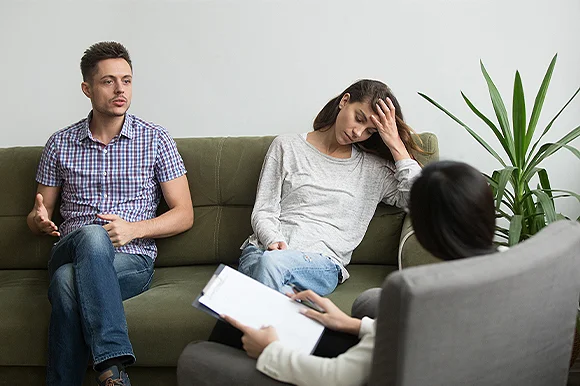
As a marriage and family therapist, I sit with individuals and couples every week who are wrestling with this exact dilemma. Some are navigating betrayal. Some are exhausted from years of conflict. Some are struggling with emotional disconnection. Others are wondering if the relationship they once fought so hard for can still be repaired.
By the time someone reaches the point of asking whether they should stay or leave, something significant has usually happened. The nervous system is sending signals. The heart is carrying weight. The relationship is asking for attention.
At Rooted Therapies, we don’t tell people whether they should stay or go. Instead, we help them slow down, get curious, and explore what is really happening beneath the surface.
Because sometimes the problem is the relationship.
And sometimes the relationship is exposing something that needs healing inside of us.
Why People Start Asking “Should I Stay or Leave?”
Most people do not wake up one morning and suddenly decide they are questioning their marriage or relationship.
More often, the question develops slowly.
It may be years of feeling unheard.
Years of carrying the emotional load.
Years of broken trust.
Years of tolerating behavior that doesn’t align with your values.
Sometimes there is a major event such as infidelity, addiction, financial deception, or a significant betrayal. Other times, it’s simply the accumulation of small hurts that were never addressed.
Think of it like a wound covered by a bandage.
The bandage may help for a while, but if the wound underneath never receives proper attention, it continues to impact the relationship.
When clients come into our North Port therapy office asking whether they should stay or leave, I often become more interested in understanding what has been ignored, tolerated, or minimized along the way.
Relationships Expose What Needs Healing
Relationships have a funny way of becoming .
The things that frustrate us, trigger us, hurt us, or terrify us often reveal deeper wounds that have existed long before the relationship began.
Attachment wounds.
Childhood experiences.
Trauma.
Fear of abandonment.
Fear of rejection.
Fear of not being enough.
Many people hope relationships will heal these wounds. Instead, relationships often expose them.
That doesn’t mean the relationship is unhealthy.
It means the relationship may be revealing something that deserves attention.
Research on attachment theory shows that our earliest experiences shape how we connect, trust, , and respond to conflict throughout adulthood. When those wounds remain unaddressed, they frequently show up in marriages, friendships, and family relationships.
The relationship may not be creating all the pain.
It may be illuminating pain that has been there all along.
Have You Done Your Work?
This is one of the most important questions I ask clients.
Not because I want them to stay.
Not because I want them to leave.
But because clarity often comes when we become willing to look inward.
Have you explored your?
Have you examined your boundaries?
Have you addressed your own healing?
Have you learned how to communicate your needs?
Have you become honest about what you tolerate and why?
The healthiest decisions often come after we’ve done the difficult work of understanding ourselves.
That doesn’t mean you are responsible for someone else’s behavior.
It doesn’t mean abuse, manipulation, or betrayal should be tolerated.
It simply means that before making life-changing decisions, it’s worth asking whether you’ve fully explored your side of the street.
Stay in Your Hula Hoop
One of the most common concepts we teach at Rooted Therapies is the Hula Hoop.
Imagine standing inside a hula hoop.
Everything inside that hoop belongs to you.
Your choices.
Your healing.
Your reactions.
Your boundaries.
Your growth.
Your partner has their own hula hoop.
One of the biggest mistakes people make in relationships is spending all their energy trying to manage what belongs inside someone else’s hoop.
You cannot force your spouse to grow.
You cannot make someone be honest.
You cannot make someone attend therapy.
You cannot heal another person’s trauma.
But you can become responsible for what happens inside your own hoop.
Many people gain tremendous clarity when they stop focusing on controlling others and begin focusing on their own healing.
Signs a Relationship Can Heal
One of the strongest indicators that a relationship can heal is a willingness to grow.
When I hear statements like:
“I know I contribute to this.”
“I can see where I’ve hurt my partner.”
“I want to understand why I keep doing this.”
“I know I have work to do.”
Hope immediately enters the room.
Growth requires ownership.
Healing requires humility.
Repair requires accountability.
Healthy relationships are not built by perfect people.
They are built by people who are willing to learn, repair, and grow.
If both individuals are actively working toward change, there is often more hope than they realize.
Signs Separation May Need to Be Considered
There are also situations where separation becomes a very real consideration.
These may include:
- Ongoing emotional abuse
- Physical abuse
- Chronic dishonesty
- Repeated betrayal without accountability
- Addiction with no willingness to seek help
- Financial deception
- Consistent boundary violations
- Refusal to participate in growth or healing
- Lack of emotional or physical safety
One of the hardest truths to accept is that you cannot work harder than another person wants to work.
Relationships require participation from both people.
If one person is continually doing the work while the other continues causing harm without accountability, that information matters.
What Contempt Looks Like in Relationships
One of the strongest predictors of divorce identified by relationship researcher John Gottman is contempt.
Contempt goes beyond frustration.
It sounds like:
“They’ll never change.”
“I don’t even like them anymore.”
“They’re a terrible person.”
“I have no respect for them.”
When contempt enters a relationship, it becomes difficult to see another person’s humanity.
The bridge between people begins to collapse.
The goal of couples therapy is often to identify contempt early and explore whether there is still enough willingness, vulnerability, and connection available to rebuild trust and understanding.
Can Marriage Counseling Save a Relationship?
One of the most common questions people ask is whether marriage counseling can save a relationship.
The answer is: sometimes.
Therapy cannot force someone to change.
Therapy cannot create motivation that doesn’t exist.
Therapy cannot undo years of hurt overnight.
What therapy can do is help people:
- Improve communication
- Understand attachment wounds
- Address trauma
- Rebuild trust
- Learn healthy boundaries
- Develop emotional safety
- Understand recurring conflict patterns
The earlier couples seek support, the better their chances of creating meaningful change.
Many couples wait until they are already discussing separation before seeking help.
Often, the work could have started years earlier.
What If My Partner Refuses Therapy?
This is another question we hear frequently.
If your partner refuses therapy, you can still begin your own healing.
Individual therapy can help you:
- Clarify your values
- Strengthen your boundaries
- Improve communication
- Understand relationship patterns
- Build confidence in your decision-making
Sometimes individual growth creates movement within the relationship.
Sometimes it provides clarity about what needs to happen next.
Either way, your healing does not have to wait for someone else’s participation.
Healing Starts with Awareness
Whatever season you are navigating, you do not have to navigate it alone.
At Rooted Therapies, we work with individuals, couples, teens, and families who are navigating relationship struggles, emotional overwhelm, trauma, attachment wounds, and the deeper work of healing. Whether you are wrestling with the question of staying, leaving, rebuilding trust, or learning how to reconnect with yourself, support is available.
If this topic resonates with you, we also invite you to take our free Should We Keep Working on This Relationship? Reflection Quiz. This self-reflection tool can help you explore important areas such as emotional safety, communication, connection, respect, and willingness to grow.
Take the Relationship Reflection Quiz
We invite you to explore , listen to the Rooted & Restored Podcast, and check out our Google reviews to hear from individuals, couples, and families who have experienced the work at Rooted Therapies firsthand.
If you are looking for marriage counseling in North Port, couples therapy, family counseling, or relationship support in Sarasota County, we invite you to schedule a free 15-minute consultation and learn more about how Rooted Therapies can support your journey.
Because healing is not about having all the answers.
It’s about becoming curious enough to ask the right questions.
Frequently Asked Questions
How do I know if my relationship is unhealthy?
Every relationship experiences conflict, stress, and difficult seasons. An unhealthy relationship is often characterized by ongoing patterns of dishonesty, emotional or physical abuse, manipulation, chronic disrespect, repeated boundary violations, or a lack of accountability. If you find yourself constantly walking on eggshells, feeling unsafe, or questioning your reality, it may be time to seek support and take a closer look at the relationship dynamics.
Can a relationship recover after infidelity?
Yes, many relationships recover after infidelity, but healing takes time. Recovery requires honesty, accountability, transparency, and a willingness to understand what contributed to the breach of trust. Rebuilding trust is often a gradual process, but many couples emerge with stronger communication and a deeper understanding of one another.
Can marriage counseling save a relationship?
Marriage counseling can be incredibly effective when both partners are willing to engage in the process. Counseling helps couples improve communication, rebuild trust, understand relationship patterns, address attachment wounds, and develop healthier ways of navigating conflict. While therapy cannot force change, it can create the environment where healing becomes possible.
What if my spouse refuses therapy?
You can still begin your own healing journey. Individual therapy can help you strengthen boundaries, gain clarity, improve communication, understand relationship patterns, and build confidence in your decision-making. Sometimes personal growth influences the relationship. Other times, it helps you determine your next steps with greater confidence.
What is the difference between a difficult season and a toxic relationship?
A difficult season typically involves stressors that both people are trying to navigate together, even if imperfectly. A toxic relationship often involves ongoing patterns of harm, manipulation, disrespect, abuse, or a refusal to take responsibility. The key difference is whether both individuals are willing to acknowledge problems and work toward healthier patterns.
What if I don’t trust myself to make the right decision?
This is more common than you might think. Many people lose trust in themselves after years of conflict, betrayal, people-pleasing, codependency, or unhealthy relationship dynamics. Before asking whether you should stay or leave, it may be important to ask whether you trust yourself. Therapy can help you reconnect with your values, boundaries, intuition, and confidence so you can make decisions from a place of clarity rather than fear.
Relationship Resources in Sarasota County
If you are experiencing relationship distress, domestic violence, emotional abuse, or a mental health crisis, the following resources may help:
SPARCC (Safe Place and Rape Crisis Center)
Provides support, advocacy, shelter, and counseling services throughout Sarasota and DeSoto Counties.
988 Suicide & Crisis Lifeline
Call or text 988 for immediate emotional support.
National Domestic Violence Hotline
Call 800-799-7233 or text START to 88788.
References
American Psychological Association. Healthy Relationships and Emotional Well-Being.
Bowlby, J. (1988). A Secure Base: Parent-Child Attachment and Healthy Human Development.
Gottman, J. M., & Gottman, J. S. (2015). The Seven Principles for Making Marriage Work.
Johnson, S. M. (2019). Attachment Theory in Practice.
Porges, S. W. (2021). Polyvagal Theory: A Science of Safety.
Substance Abuse and Mental Health Services Administration (SAMHSA). Trauma-Informed Care Principles.
Van der Kolk, B. A. (2014). The Body Keeps the Score.